Heat and Noise Management for Small Mining Operations
Every watt a mining machine consumes leaves the room as heat: a 20 TH/s unit at 20 J/TH draws 400 W, so it is a 400 W heater, roughly 1,365 BTU per hour, running continuously. At the read-date network hashrate and an $84,692 BTC price that machine earns about $0.76 gross and $0.73 after the listed 4% fee, against about $0.58 of electricity at $0.06 per kWh — a margin of roughly $0.15 a day that a single cooling mistake can erase.

Key takeaways
- Treat cooling as an efficiency problem with a number attached: at 2 PH/s, a 1 J/TH penalty is 2 kW, or 48 kWh a day — about $2.88 at $0.06 per kWh, every day.
- Throttling is the expensive version of heat. Five percent of hashrate lost to thermal derate at 2 PH/s is about $3.80 a day of income that never gets mined.
- Noise is a mechanical problem with an electrical cost: quiet fan curves raise temperatures, and raised temperatures become throttle events during the hottest hours of the year.
- At 20 TH/s the whole daily margin is about $0.15, so heat management is not about optimisation at that size — it is about not losing money to a closed door or a clogged filter.
The core idea
Mining hardware converts electricity almost entirely into heat and hashes. There is no meaningful exhaust of anything else, so the cooling requirement is not a design preference — it is the power draw restated in thermal terms. A 400 W machine needs 400 W of heat carried away; a 40 kW rack needs 40 kW carried away, about 136,000 BTU per hour.
The failure mode is always the same shape: heat leaves the machines, recirculates, and re-enters the intakes. Intake temperature rises, the control loop reduces frequency to keep silicon within limits, and hashrate falls while power draw stays roughly the same. J/TH rises, margin falls, and nothing in the income dashboard explains why.
The pool side of the equation stays exactly where it was. Shares that are not submitted are not paid, whatever the fee structure: a listed 4% on the PPS-settled block reward and 2% on the PPLNS-distributed components applies to the shares you actually deliver.[1]
How it plays out at scale
| Fleet | Power draw | Heat load | Daily electricity at $0.06/kWh | Daily income, gross / net of listed 4% |
|---|---|---|---|---|
| 20 TH/s | 400 W | About 1,365 BTU/h | $0.58 | $0.76 / $0.73 |
| 200 TH/s | 4 kW | About 13,650 BTU/h | $5.76 | $7.60 / $7.29 |
| 2 PH/s | 40 kW | About 136,500 BTU/h | $57.60 | $75.99 / $72.95 |
| 20 PH/s | 400 kW | About 1,365,000 BTU/h | $576.00 | $759.87 / $729.47 |
Read the table as a decision ladder. At 20 TH/s, air movement matters more than any equipment: a door left closed or a filter left clogged can cost more than the machine earns, because the margin is about $0.15 a day. At 200 TH/s the margin is about $1.53 a day and a single throttling event starts to be visible. At 2 PH/s the site needs genuine hot-aisle and cold-aisle separation; the margin is about $15.35 a day and heat management is now the main operational discipline.
Noise tracks the same curve. Fan RPM rises as intake temperature rises, and acoustic output rises faster than RPM does. That is why a quiet operation and a hot operation are usually the same problem described from two directions: the profile that reduces noise raises temperatures, and the temperatures eventually take the hashrate back.
Two scenarios compared
Scenario A: a 20 TH/s machine in a spare room. Power is 400 W, heat about 1,365 BTU/h, electricity about $0.58 a day, income about $0.73 net of the listed 4% fee. The margin is roughly $0.15 a day, or about $4.50 a month. The practical plan is modest: keep the intake cool, do not recirculate the exhaust, keep the intake filter clean, and accept that the machine's fan noise is the price of the airflow it needs. Spending money on an elaborate cooling system here is spending more than the machine earns.
Scenario B: a 2 PH/s deployment in a dedicated space. Power is 40 kW, heat about 136,500 BTU/h, electricity about $57.60 a day and income about $72.95 net of the listed fee, leaving roughly $15.35 a day. Here cooling is worth engineering: a 1 J/TH penalty is 2 kW, 48 kWh a day and about $2.88, while a 5% throttle event costs about $3.80 of income. Noise management is also a contractual matter at this size, since the same 40 kW of fans that keep the silicon cool is what neighbours notice.
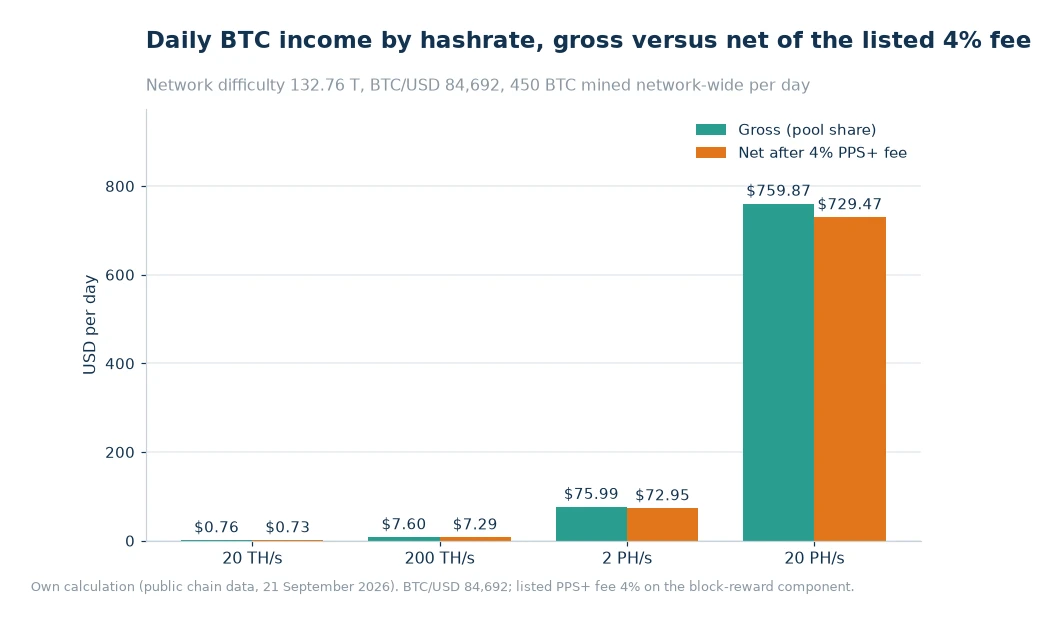
The chart is the reason to fix cooling before adding machines. Income scales linearly with hashrate, but throttle losses scale with efficiency, so a deployment that is already running warm will convert every additional machine into a larger cooling problem and a smaller marginal return. Two tools settle that question quickly: a profit calculator for the expected income side, and a power meter for the real draw at the wall rather than the manufacturer's figure.
Common failure modes
- Exhaust recirculation. The most common cause of a slow, unexplained hashrate decline in small rooms: hot air finds the intake again.
- Filters treated as optional. A clogged intake filter raises temperature everywhere downstream and is invisible on any dashboard.
- Quiet fan curves in summer. A profile tuned in winter will throttle in July, and the loss shows up as income rather than as an error.
- Adding machines without adding airflow. Doubling hashrate doubles the heat load; the cooling design does not scale with it by default.
- Measuring noise instead of measuring temperature. The number that affects income is intake temperature, and it is measurable on most firmware dashboards.
- Ignoring the dehumidification question. Damp environments and electronics age badly; if the space is humid, that belongs in the plan alongside temperature and airflow.
When the numbers stop justifying the space, hosted capacity is the honest alternative: the heat, the noise and the airflow become a contract rather than a project. That is the reasoning behind the ViaBTC Bitcoin Mining approach of keeping mining, settlement and the account in one place, so the operational decision is about where capacity runs rather than about building a room for it.
Whatever the arrangement, keep the earnings visible. Payouts that land in the same account that holds the hardware budget make it obvious whether a month of cooling work paid for itself, which is the only test that matters at small scale — and a multi-currency wallet beside the mining dashboard removes the transfer steps that otherwise blur the comparison.
Frequently asked questions
Is a bigger pool always better?
Size reduces payout variance but also concentrates hashrate. What matters more is fee structure, uptime, latency and payout cadence.
What happens if my miner goes offline?
Shares stop, so expected income stops with them. Alerts and a dashboard that shows per-worker hashrate shorten the gap between a failure and a fix.
How much heat does a mining machine produce?
Almost all of its electricity becomes heat, so a 400 W machine is a 400 W heater, about 1,365 BTU per hour. At 2 PH/s with 20 J/TH hardware the heat load is about 40 kW, or roughly 136,500 BTU per hour.
Why does hashrate fall on hot days?
Cooling air recirculates or the intake temperature rises, so the control loop reduces frequency to keep silicon within limits. Power draw barely changes, which means J/TH worsens and the missing hashrate shows up as lost income rather than as an error.
The short version
Convert heat into money before spending money on it. At 20 TH/s the margin is about $0.15 a day, so clean filters and airflow beat equipment. At 2 PH/s a single J/TH of cooling overhead costs about $2.88 a day and a 5% throttle event about $3.80, which justifies real engineering. Fix the airflow curve first, then the noise curve, then add machines — in that order, because the reverse order is how small operations end up with a hot room and a flat income line.
Data and sources: ViaBTC fee schedule and mining documentation[1] and the ViaBTC pool statistics view[2]. Network hashrate, difficulty, subsidy and BTC price read from public chain data on 21 September 2026. Power and heat figures are illustrative models based on 20 J/TH hardware.