Most production problems are not manufacturing failures; they are decisions made before manufacturing starts. The four that catch first-time brands hardest are an under-specified brief, a sample approved under the wrong conditions, packaging ordered before the fill is fixed, and a compliance file assembled at the last minute. Each is cheap to prevent and expensive to fix once a bulk batch is in progress.
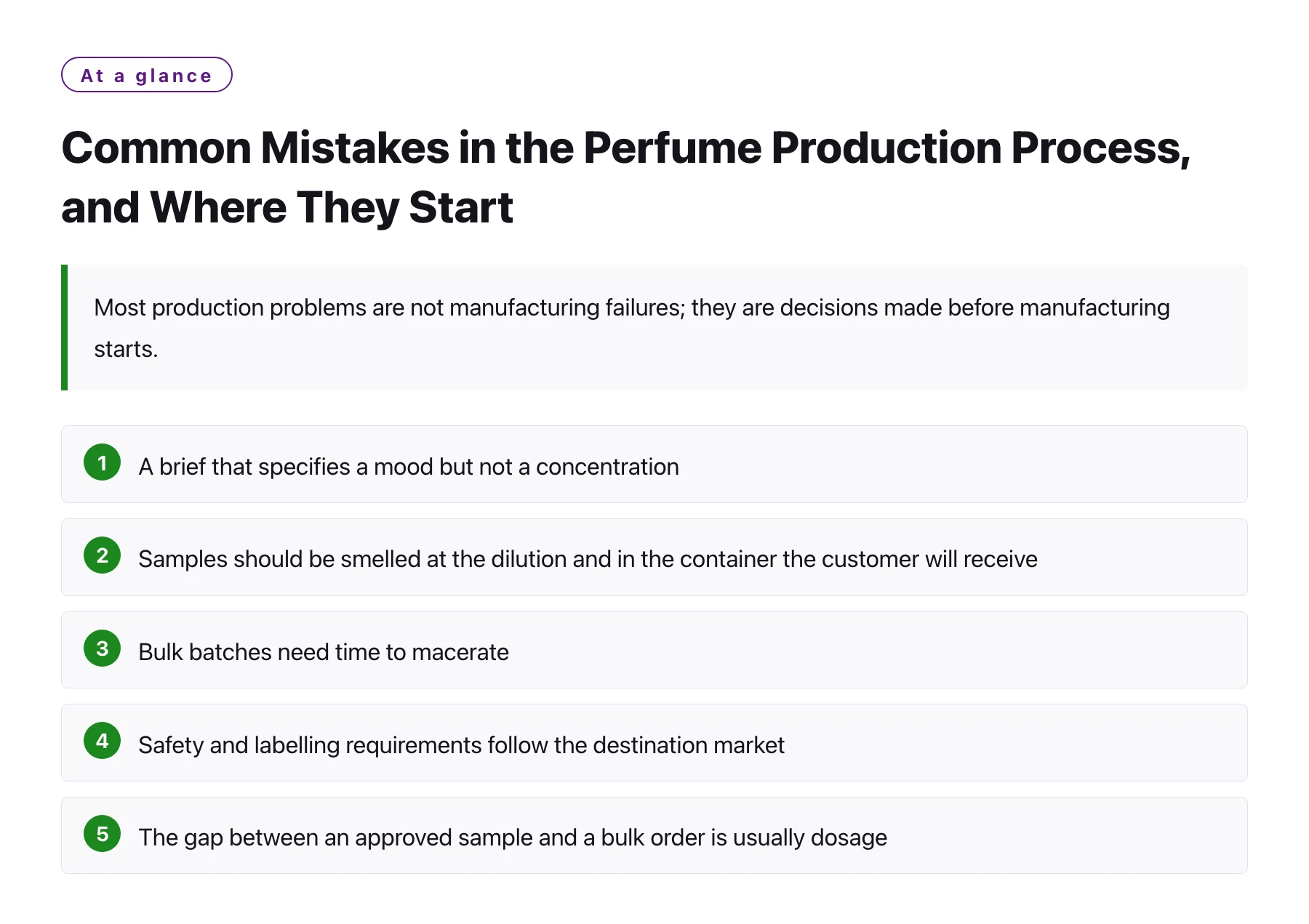
Key takeawaysA brief that specifies a mood but not a concentration, a fill volume and a target cost will produce a sample nobody can approve or reject cleanly. · Samples should be smelled at the dilution and in the container the customer will receive, because both change how a formula reads. · Bulk batches need time to macerate, fill and rest, so packaging artwork and components must be frozen before compounding begins. · Safety and labelling requirements follow the destination market, which puts the document list in the brief stage rather than the shipping stage. · The gap between an approved sample and a bulk order is usually dosage, ageing or a material substitution, and each of those can be monitored rather than argued about later.
A creator launching a fragrance line usually arrives at the factory with two things: a scent direction and a launch date. The factory can work with the first and rarely controls the second. What sits between them is a process with a predictable set of failure points, and knowing them in advance is most of the work.
The list below is drawn from the mistakes that recur across first production runs. None of them are exotic. All of them are ordinary decisions that look small at the time and become large at volume.
Four mistakes and where they start
| Mistake | How it shows up | What prevents it |
|---|---|---|
| A brief written as a mood board | The first samples miss in a way nobody can articulate | Specify concentration, fill volume, target cost and destination market in writing |
| Approval by photograph | The bulk order is the first time anyone smells the real formula in the real bottle | Approve a retained physical sample, in the final pack, signed by both sides |
| Packaging ordered on a hunch | Decoration or components arrive after the fill date and stall the launch | Freeze artwork and component specifications before the batch is compounded |
| Compliance treated as paperwork | A shipment waits weeks for a document that should have been requested at the brief stage | Build the document list into the brief and confirm who issues each item |
| One sample, one decision | The formula is approved before ageing and dosage effects are visible | Plan two iterations with a realistic ageing window between them |
Read the third row twice. Packaging is the most common cause of a launch slipping, and it usually slips quietly, because the scent was never the problem.
Where the process actually begins
The production process is often drawn as a line that starts at compounding. In practice it starts with a specification. Compounding, filling and testing are all repeatable steps that follow a written definition, and if the definition is vague, the process is being asked to hit a target that has not been described.
This is the point where a good manufacturer earns its fee. A supplier with real development experience will convert a direction into measurable parameters: a concentration, a reference sample, a fill weight, a colour tolerance, an ageing period. A supplier that simply says yes to everything is transferring that work back to you.
The brief is a production document
Write the brief as though someone who has never smelled your mood board has to build from it. That means stating the family, the reference products, the concentration, the bottle format and the market. A manufacturer's own walkthrough of the stages of perfume production is a useful checklist to write against, because each stage in it consumes a decision you either made or left open.
Concentration and container belong together
Fragrance materials are assessed for safe use at defined levels, and those levels depend on how the product is used and how much is applied [1]. That is one reason a formula cannot be judged in the abstract. The same concentrate in a rollerball and in a pressurised spray produces two different experiences and, in some cases, two different compliance conversations.
Mistakes that only appear at volume
Small batches forgive a lot. A hundred units can be hand-checked, hand-filled and hand-packed by people who know what the sample looked like. At ten thousand units, the process has to carry the specification instead of the people, and any gap in the documentation becomes visible.
Substitution without a conversation
Materials run short, harvests vary and suppliers change. Sometimes a substitution is genuinely equivalent; sometimes it shifts the drydown. The mistake is not the substitution, it is making it silently. Ask at the brief stage which materials are held in stock and which are bought per batch. A plant organised as fragrance manufacturing under one roof can usually answer that precisely, and that answer tells you where the risk sits.
The chemistry behind the risk is not mysterious. Materials differ in volatility, and volatility is what produces the top, heart and base structure of a scent [2]. Swap a material in the base and the change appears an hour after spraying, long after everyone has stopped paying attention to the sample.
Approval that nobody can reproduce
An approved sample is only useful if it can be traced. The reference should be a sealed physical sample from a defined batch, labelled with a date, a batch number and a formula reference, with one copy held by each side. Independent testing services describe this traceability as a basic expectation of cosmetic manufacturing rather than an optional extra [3], which is a reasonable standard to hold a fragrance supplier to.
If the launch date is fixed and the process is not, move the date rather than the checks. Compressing compounding, ageing or testing to hit a calendar is the one shortcut that reliably produces a second, larger problem: a batch that has to be reworked or written off while the marketing spend is already running.
What the first bulk order should prove
The first bulk order is a process test before it is a product. It should confirm three things: that the supplier can repeat the approved sample, that the quoted lead time was real, and that the document pack satisfies the importer. If any of the three fails on a small run, a larger run will not fix it.
It should also give you a comparison point. Keep the approved reference sample and smell it against the bulk delivery, then against the same bottle three months later. Some drift between a sample and a bulk order is normal and explainable, and knowing which causes are normal is what turns a disagreement into a technical conversation why a sample and the bulk order can differ.
Sources
- IFRA: Safe Use and Fragrance Science —— IFRA's explanation of how fragrance materials are scientifically assessed for safe use and how those conclusions are applied by the industry.
- Chemistry World (Royal Society of Chemistry) —— The Royal Society of Chemistry's magazine, covering chemistry research and explanations of everyday materials including aroma compounds.
- SGS: Cosmetics, Personal Care & Household Testing —— Testing, inspection and certification services for cosmetics and personal care, including microbiological, stability and safety testing aligned with cosmetics GMP.
Frequently asked questions
How long does the perfume production process take from approval to delivery?
It varies with the formula and the packaging, but the sequence is consistent: compounding, maceration, filling, decoration and packing, then testing and release. Packaging components and any new mould are usually the longest items, which is why they should be specified before compounding rather than after.
Can I skip the second round of samples to save time?
You can, and many brands do, but you are trading a few weeks for a larger risk. The second round is where dosage and ageing effects become visible. If the schedule is tight, shorten the ageing window rather than removing the second sample entirely.
Who owns the formula if the manufacturer develops it?
That depends on the agreement, not on who did the work. Exclusivity and ownership of the formula, the mould and the artwork should be settled in writing before the first sample, because changing those terms later is far more expensive than agreeing them early.
What is a normal fill weight tolerance?
Ask the supplier to state it in the specification and then verify it on the first delivery. The exact figure matters less than having a written number that both sides accepted, because a tolerance agreed in advance is what makes an inspection objective.
Should the sample be approved on skin or on paper?
On skin, at the final concentration, more than once. Paper is useful for comparing raw materials during development, but it hides how a formula develops on a person, which is the version your customer will actually experience.