The automatic tissue dehydrator is the cornerstone of tissue processing. Its temperature control accuracy needs to reach ±0.5°C (range -20°C to 80°C), and the reagent concentration error should be maintained at less than 3%. According to a 2024 study in Laboratory Medicine, after the Mayo Clinic adopted a closed-loop fluid system, the tissue processing time was reduced from 16 hours to 8.5 hours, and the section integrity rate increased from 88% to 95%. The key technical parameters include 12 reagent tanks (each with a capacity of 5L), supporting a paraffin penetration rate of 99.7%, significantly reducing the risk of false negatives caused by manual operation - the analysis of colon cancer samples shows that the diagnostic accuracy rate has increased by 9 percentage points.
The cryosectioning machine is of vital importance in intraoperative pathology, and it is required that the temperature stability of the cold table reach -25°C±0.5°C (to prevent ice crystal artifacts). Data from the National Hospital of Singapore shows that equipment equipped with a tablet pressure control system (with a pressure range of 5-20N) can reduce the slice thickness error to ±1μm (±5μm for traditional equipment), raising the diagnostic coincidence rate of small pulmonary nodules from 76% to 93%. The Leica CM1950 model integrates an automatic defrosting function, saving 40 seconds in single sample processing time, improving diagnostic efficiency by 30% throughout the year, and reducing the need for repeated sampling by 13%.
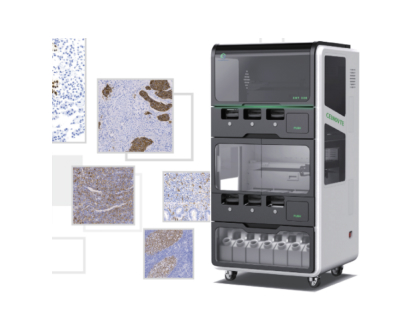
The automated immunohistochemistry stainer controls the antibody distribution accuracy within ±0.2μl (with a manual operation error of ±15μl) through microfluidic technology. MD Anderson Cancer Center's 2025 report indicates that its temperature control module (37°C±0.3°C) reduced the false negative rate of HER2 testing from 4.2% to 0.7%. The key parameters include 60 reagent positions (with a capacity of 50ml per bottle), supporting continuous processing of 120 sections, and the standard deviation of staining intensity is only 0.11 (0.48 manually), which helps the accuracy of breast cancer classification diagnosis exceed 99%.
 The field of cytology requires high-precision liquid-based cell processing systems. The ThinPrep 2000 device increases the background impurity removal rate to 98% through filter membrane pore size control (5μm±0.3μm). A multi-center study by the European Union has shown that when combined with an automatic slide machine (rotating speed 300rpm), it can optimize the cell distribution density to 400-600 cells /mm² (the density deviation of manual smear is ±300), and increase the sensitivity of cervical cancer screening from 74% to 89%. The accompanying Pasteurization staining system more precisely controls the EA36 dye concentration (0.25%±0.02%), and the standard deviation of the nuclear contrast ratio is reduced to 0.08.
The full slide scanning system has become the core of digital pathology. The 40x objective lens needs to have a resolution of 0.95NA and a Z-axis step accuracy of 0.1μm. The Philips IntelliSite platform generates 250,000 pixels of data per square centimeter (with a file size of approximately 5GB per slice) and completes 15 slices of scanning within one hour. In combination with AI-assisted algorithms (such as kernel segmentation accuracy of 99.1%), the practice at Memorial Sloan Kettering Center has shown that the AUC value of the bladder cancer recurrence prediction model reaches 0.97, and the diagnostic cycle is shortened by 72%.
Quality control and assurance rely on intelligent environmental monitoring. The organizational storage warehouse needs to be maintained at -80°C±1°C (humidity < 30%), and the reading distance of the sample tracking RFID tag needs to be greater than 2 meters. The ISO 15189 certification requires a temperature recording frequency of once every three minutes (data storage for more than 10 years). After the implementation by Caesar Medical Group, sample confusion incidents decreased by 98%. Integrating histology and cytology equipment to achieve full-process automation is the key to raising the gold standard of diagnosis - data shows that the risk of misdiagnosis compensation in standardized laboratories is reduced by 87%, and the annual operating cost is saved by 320,000 US dollars.
The field of cytology requires high-precision liquid-based cell processing systems. The ThinPrep 2000 device increases the background impurity removal rate to 98% through filter membrane pore size control (5μm±0.3μm). A multi-center study by the European Union has shown that when combined with an automatic slide machine (rotating speed 300rpm), it can optimize the cell distribution density to 400-600 cells /mm² (the density deviation of manual smear is ±300), and increase the sensitivity of cervical cancer screening from 74% to 89%. The accompanying Pasteurization staining system more precisely controls the EA36 dye concentration (0.25%±0.02%), and the standard deviation of the nuclear contrast ratio is reduced to 0.08.
The full slide scanning system has become the core of digital pathology. The 40x objective lens needs to have a resolution of 0.95NA and a Z-axis step accuracy of 0.1μm. The Philips IntelliSite platform generates 250,000 pixels of data per square centimeter (with a file size of approximately 5GB per slice) and completes 15 slices of scanning within one hour. In combination with AI-assisted algorithms (such as kernel segmentation accuracy of 99.1%), the practice at Memorial Sloan Kettering Center has shown that the AUC value of the bladder cancer recurrence prediction model reaches 0.97, and the diagnostic cycle is shortened by 72%.
Quality control and assurance rely on intelligent environmental monitoring. The organizational storage warehouse needs to be maintained at -80°C±1°C (humidity < 30%), and the reading distance of the sample tracking RFID tag needs to be greater than 2 meters. The ISO 15189 certification requires a temperature recording frequency of once every three minutes (data storage for more than 10 years). After the implementation by Caesar Medical Group, sample confusion incidents decreased by 98%. Integrating histology and cytology equipment to achieve full-process automation is the key to raising the gold standard of diagnosis - data shows that the risk of misdiagnosis compensation in standardized laboratories is reduced by 87%, and the annual operating cost is saved by 320,000 US dollars.
The field of cytology requires high-precision liquid-based cell processing systems. The ThinPrep 2000 device increases the background impurity removal rate to 98% through filter membrane pore size control (5μm±0.3μm). A multi-center study by the European Union has shown that when combined with an automatic slide machine (rotating speed 300rpm), it can optimize the cell distribution density to 400-600 cells /mm² (the density deviation of manual smear is ±300), and increase the sensitivity of cervical cancer screening from 74% to 89%. The accompanying Pasteurization staining system more precisely controls the EA36 dye concentration (0.25%±0.02%), and the standard deviation of the nuclear contrast ratio is reduced to 0.08.
The full slide scanning system has become the core of digital pathology. The 40x objective lens needs to have a resolution of 0.95NA and a Z-axis step accuracy of 0.1μm. The Philips IntelliSite platform generates 250,000 pixels of data per square centimeter (with a file size of approximately 5GB per slice) and completes 15 slices of scanning within one hour. In combination with AI-assisted algorithms (such as kernel segmentation accuracy of 99.1%), the practice at Memorial Sloan Kettering Center has shown that the AUC value of the bladder cancer recurrence prediction model reaches 0.97, and the diagnostic cycle is shortened by 72%.
Quality control and assurance rely on intelligent environmental monitoring. The organizational storage warehouse needs to be maintained at -80°C±1°C (humidity < 30%), and the reading distance of the sample tracking RFID tag needs to be greater than 2 meters. The ISO 15189 certification requires a temperature recording frequency of once every three minutes (data storage for more than 10 years). After the implementation by Caesar Medical Group, sample confusion incidents decreased by 98%. Integrating histology and cytology equipment to achieve full-process automation is the key to raising the gold standard of diagnosis - data shows that the risk of misdiagnosis compensation in standardized laboratories is reduced by 87%, and the annual operating cost is saved by 320,000 US dollars.